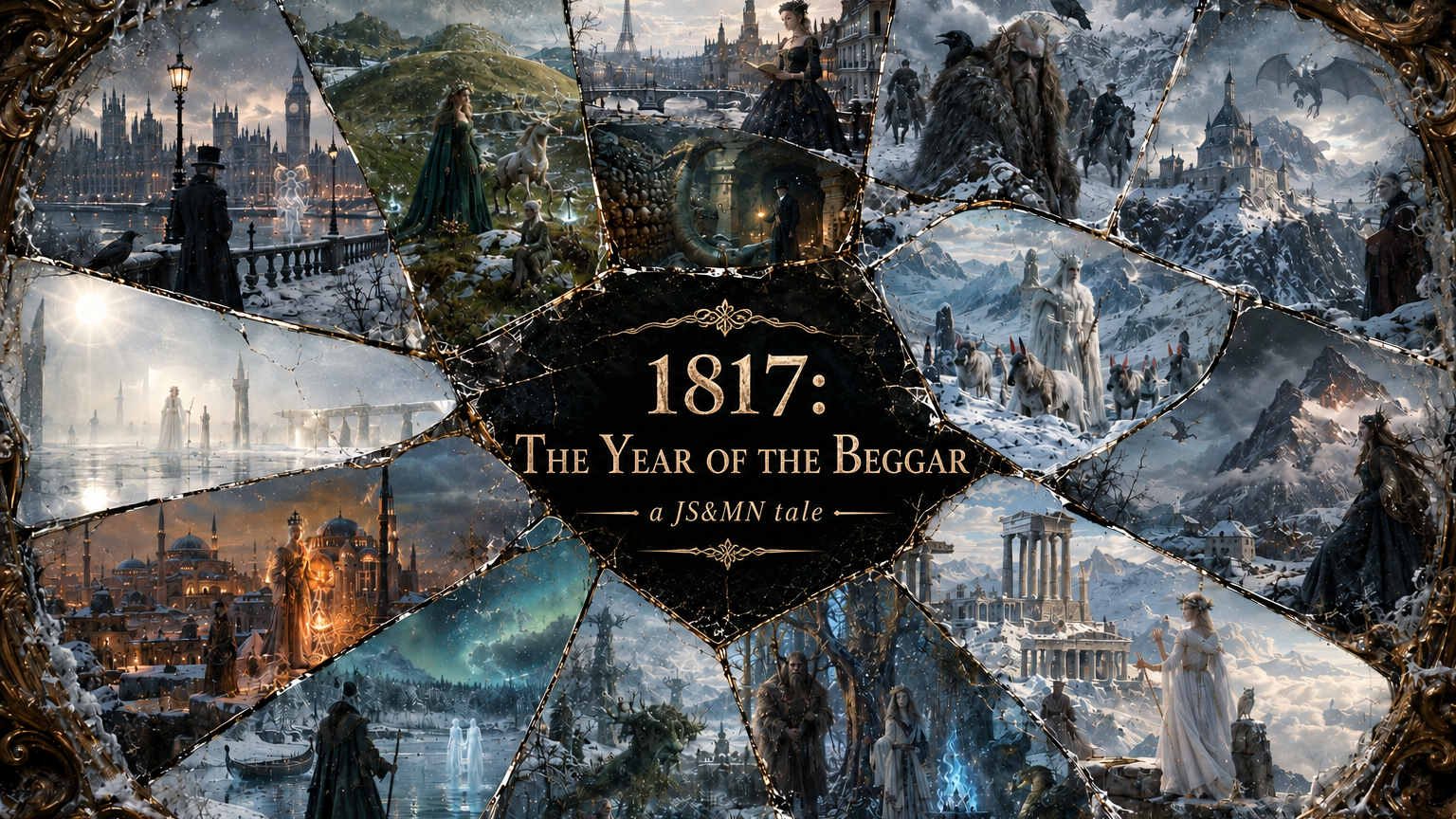
1817: The Year of the Beggar a JS&MN tale
Magic returned the same year the harvest didn't, The Fae noticed both, old debts come due. The Good Folk don't take no for an answer. The premise begins with Susanna Clarke's novel Jonathan Strange & Mr Norrell a landmark of British fantasy in which magic never disappeared from England, it simply stopped being practiced. Two magicians change that: Gilbert Norrell, a scholar who hoards magical texts and despises sharing them, and Jonathan Strange, his reckless, brilliant former pupil who publishes freely and courts madness for power. Between them they've cracked something open. What looks like an English story about two arguing gentlemen is, underneath, the first tremor of a continental earthquake. The game picks up in February 1817, three months before Clarke's novel reaches its climax and expands the scope to all of Europe. Because when the Raven King's spell began working through Strange and Norrell as its unwitting instruments, the shockwaves didn't stop at the English Channel. Every dormant alliance between mortal peoples and Fae courts severed by centuries of Christianization, suppression, and forgetting snapped back into force simultaneously. The Irish Sídhe in their hollow hills. The One-Eyed Lord's Wild Hunt across Scandinavia. The Mélusine Court's lawyers emerging from beneath Paris with contracts no one remembers signing. Eleven courts waking at once, each convinced it is the only legitimate power, all of them collecting on ancient debts. The accelerant was a volcano. Mount Tambora erupted in April 1815, blotted out the summer of 1816, and turned 1817 into Das Jahr des Bettlers the Year of the Beggar. Wheat prices doubled. Typhus spread through the slums. Food riots broke out from Lancashire to Bavaria. The same volcanic ash that starved the harvest also thinned the boundary between the mortal world and Faerie