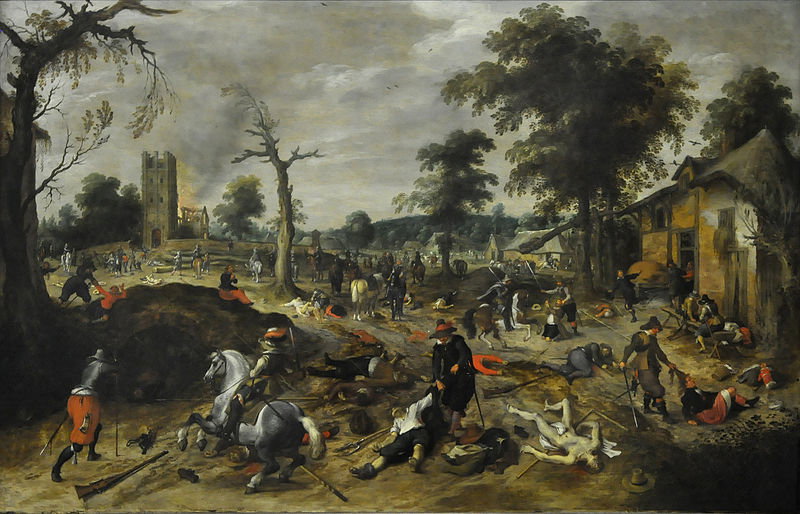
Thirty Years War | 1618 - 1648
The Thirty Years' War, fought primarily in Central Europe between 1618 and 1648, was one of the most destructive conflicts in European history. An estimated 4.5 to 8 million soldiers and civilians died from the effects of battle, famine, or disease, with parts of Germany reporting population declines of over 50%. Related conflicts include the Eighty Years' War, the War of the Mantuan Succession, the Franco-Spanish War, the Torstenson War, the Dutch–Portuguese War, and the Portuguese Restoration War. The war began in 1618, when the Catholic Emperor Ferdinand II was replaced as king of Bohemia by the Protestant Frederick V of the Palatinate. Although Frederick was swiftly deposed, his participation meant fighting expanded into the Palatinate. Their strategic importance drew in the Dutch Republic and Spain, then engaged in the Eighty Years' War, while the acquisition of imperial territories gave rulers like Christian IV of Denmark and Gustavus Adolphus of Sweden ongoing motives to intervene. These factors, together with Protestant fears that their religion was threatened, transformed an internal dynastic dispute into a wider conflict. The period from 1618 to 1635 was primarily a civil war within the Holy Roman Empire, which largely ended with the Peace of Prague. However, France's entry into the war in alliance with Sweden turned the empire into one theatre of a wider struggle with their Habsburg rivals, Emperor Ferdinand III and Spain. Fighting ended with the 1648 Peace of Westphalia, whose terms included greater autonomy for states like Bavaria and Saxony, Swedish territorial gains in northern Germany, as well as acceptance of Dutch independence by Spain. The conflict shifted the balance of power in favour of France and its subsequent expansion under Louis XIV. Can you survive this deadly period of Europe?